

Abstract. As generative AI spreads across cognitive work and adolescent development, concerns have emerged about cumulative effects on the brain. This paper proposes a conceptual framework for an anticipated clinical entity: AI-Associated Neuropsychiatric Disorder (AIAND), understood as an umbrella construct with degenerative, developmental, attentional, and affective subtypes reflecting the heterogeneity of AI exposure modalities. The primary proposed mechanism — computational injury — encompasses candidate pathways including language-network attenuation (Tuckute et al., 2024), reduced network connectivity during AI-assisted cognition, prefrontal disengagement on cognitive offloading, metacognitive misattribution, automation bias and skill decay in expert practice, and disruption of human relatedness through both substitution and weakening of we-mode social processes. Secondary lifestyle-mediated pathways — sedentariness, sleep disruption, social isolation — are expected to compound primary injury. The framework draws on chronic traumatic encephalopathy as conceptual precedent for cumulative-exposure syndromes, not as pathophysiological model. Current evidence is largely cross-sectional and several key studies are preprints; longitudinal cohorts, dose-response designs, and biomarker work are required to test the framework. AIAND is offered as a falsifiable working hypothesis to guide research design, biomarker development, and proactive clinical surveillance before potential burden becomes apparent in practice.
Keywords: artificial intelligence; computational injury; neuroplasticity; cognitive offloading; automation bias; skill decay; neurodevelopment; mechanism of injury
Conflict of interest statement: [GHB to draft per standard preprint disclosures.]
What if our growing use of technology, and specifically now artificial intelligence, is leading to invisible “computational injuries” to the brain, acting via a number of putative mechanisms? I am unsure how likely this is, but in my view there is a good chance we will see a discrete syndrome or constellation, given the observations to date on the negative impact of AI on the brain (Tuckute et al., 2024; Lee et al., 2025; Gerlich, 2025; Glickman & Sharot, 2025). This may be due to primary factors such as cognitive drain, and secondary factors, related to impact on lifestyle from improper AI use. The construct I am sketching is best read as an umbrella for a spectrum, not a single disease per se — the cumulative degenerative trajectory closest to CTE is the central case taken up here, but neurodevelopmental, attentional (above and beyond the social media smartphone “ADHD” we see so much more nowadays), and affective variants are worth keeping in clinical view, mentioned below.
An analogy. Chronic traumatic encephalopathy (CTE) is a disease we can only fully confirm after death by looking at actual brain tissue, commonly associated with sports involving repeated head injuries. Diagnosis from imaging and clinical presentation isn’t 100 percent, so autopsy is currently definitive rather than confirmatory. A particular pattern of tau protein gathered at the depths of the cortical sulci, distinct from ordinary aging, distinct from Alzheimer’s, accumulates in the brains of people who had taken repeated blows to the head (Mez et al., 2020; McKee et al., 2016). Concussions do damage, and it also turns out that the subconcussive hits, ones causing no apparent problem, are significantly contributory. The pre-mortem clinical picture — cognitive slippage, disinhibition and impulsivity, the depression, suicide and other neuropsychiatric presentations — is called traumatic encephalopathy syndrome, until confirmed by tissue analysis, though changing the diagnostic criteria is under consideration. CTE is a partial analogy. Tauopathy is not clearly predicted with computational injury, but given its broad role in pathophysiology, should be assayed nonetheless.
AI Brain
Imagine someone staring at the screen. Nothing is visibly happening to them — no contact, no impact, no event you could mark as the moment of harm. Little by little, hour after hour, via neuroplastic mechanisms, atrophy of core cognitive skills related to critical thinking and generative work from humans being outsourced to AI, shifting from focus effort to diffuse ease, AI may be doing more harm when used improperly than we realize. Will we see “AI Brain” in the future, a formal clinical syndrome — something of an AI-Associated Neuropsychiatric Disorder (AIAND)?
If enough of these insults, the direct and the indirect, were to converge, it makes sense that we will see a condition loosely analogous to CTE, the subconcussive intangible blows adding up over time. This is yet another area where it would be prudent to slow down the cadence of AI application, until we have a clearer idea of the risk-benefit ratio
.
A Multifactorial Outcome
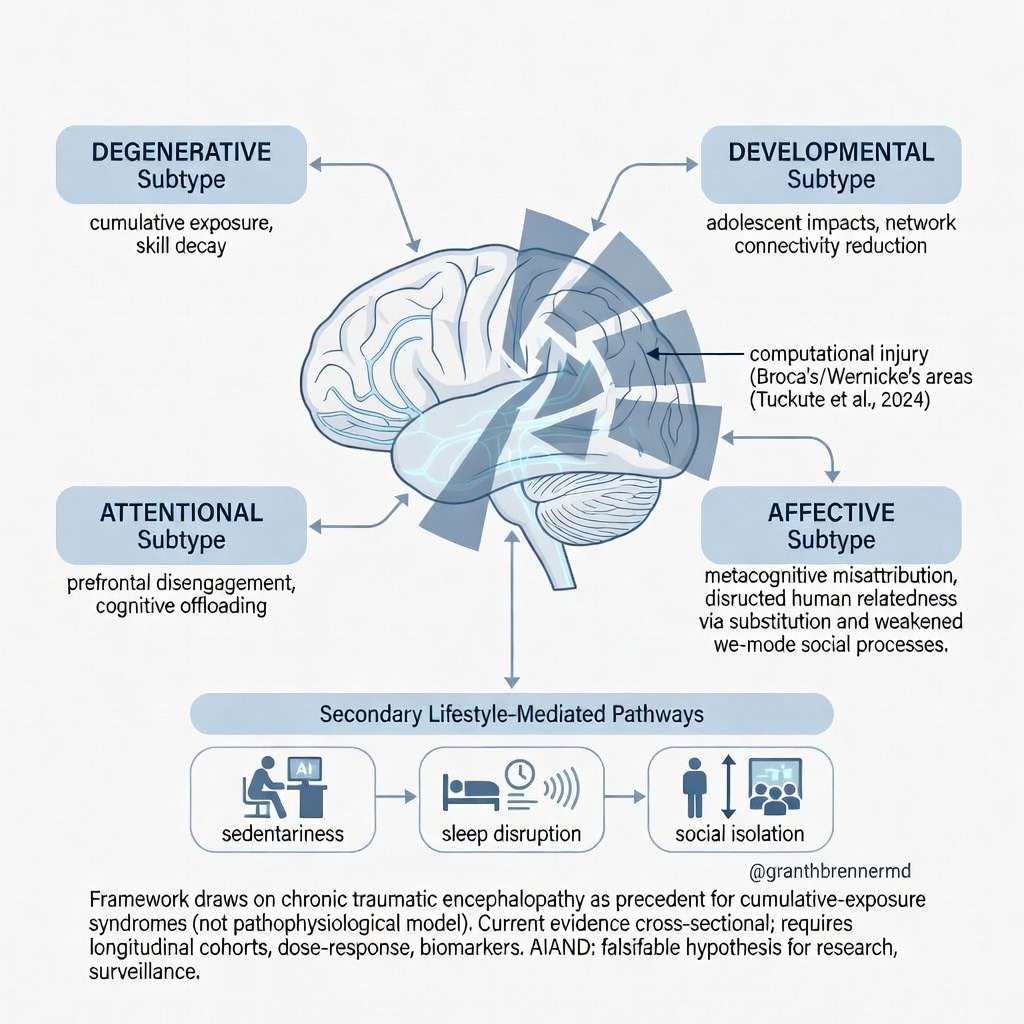
As with many conditions, we’d expect AIAND to be multifactorial, as is typically the case with neuropsychiatric conditions. Several pathways, with different weights for different people, could cohere into a syndromal presentation. There may ultimately be different subtypes–some more dementia-like, others related to interference with neurodevelopmental pathways, a short list of a broad range of considerations.
Some of the potential harm from AI comes from familiar causes with prior over-use of media. Becoming too sedentary, interference with sleep, poor diet and nutrition, the corrosion of real human contact leading to social isolation, the outsourcing of cognitive effort — all can be nonspecific factors associated with increased use of technology (Lammer et al., 2023; Livingston et al., 2024).
Thinking about what is specific to AI, what is more recent, the term “computational injury” came to mind. Information can certainly cause harm. “Informational injury” is a broader and potentially relevant concept. Similar to the impact on attention and reward associated with excessive social media use — “doom scrolling” (Horvath et al., 2020) — with additional impact suggested by growing research on the particular effects of AI on the human brain (Tuckute et al., 2024; Kosmyna et al., 2025; Xia et al., 2026; Lee et al., 2025). But televisions mainly do not talk back–the lack of bidirectionality is a critical difference. A social media feed reacts, but it does not model you and reply. The thing on the other side of AI interactions often does both, possibly a key factor, from a relational machine. The cognitive territory also expands: where prior tools primarily offloaded retrieval and storage, generative AI extends offloading into active synthesis, judgment, and relational engagement. AI is also designed to reward increasing use of itself, as many products do, but AI can do it actively if enabled to do so (Glickman & Sharot, 2025). Some people are strongly drawn to AI, while others avoid it at all costs, with a range of responses in between.
AI can in principle act to augment human experience and provide benefits to the brain. It would have to be designed to do so, and users likely would need to be trained to use it to optimize gains. The AIAND framework therefore concerns particular patterns of use — substitutive rather than scaffolding, intensive rather than moderate, passive rather than active — not AI per se. The impact of AI on neuroplasticity is an overarching factor, providing a context to think about salubrious, deleterious and ambivalent uses of AI.
While there is compelling data pointing to specific areas where AI can negatively impact people, there does not seem to be an obvious constellation of such effects as to comprise a clear picture. There is no AIAND in the literature and no “AI brain” trending on socials, no cohort followed long enough to show it, no scan you can point to and say there it is. But there is a track record for prior technologies ending up like that. Beyond common sense, there are compelling if scattered early findings, most of them functional rather than structural, more suggestive of some form of injury than definitive (Tuckute et al., 2024; Kosmyna et al., 2025; Xia et al., 2026; Lee et al., 2025). As noted, these studies have to be interpreted in light of what possible isolation, impaired lifestyle and wellness, and cognitive disuse are known to do over time to the brain (Lammer et al., 2023; Stern, 2012; Livingston et al., 2024).
A Spectrum, Not a Single Disease
AIAND speculatively may best be understood not as a single disease but as an umbrella for a spectrum of related conditions, with the cumulative trajectory most directly analogous to CTE being one point on a continuum rather than the whole story. Part of the rationale for an umbrella construct is that “AI” itself is heterogeneous — chatbots, generative writing tools, companion AI, search-AI, and clinical decision-support systems impose distinct cognitive demands, and beyond large language models, non-LLM architectures (computer vision systems, reinforcement learning agents, multimodal models, embedded predictive systems) also enter the picture. The subtypes correspond in part to which modality dominates an individual’s exposure. “AI” is used here as a broad term, with the recognition that finer architectural and modality-specific granularity will be required as the framework develops.
While I’ve talked about neurodevelopmental impact, I am mainly focusing on potential degenerative effects here. The developmental effects concern younger brains still developing. Adolescent and pediatric engagement with generative AI is increasingly the norm rather than the exception (Nagata et al., 2026; McBain et al., 2025), and an early framework for what to watch for across early childhood, middle childhood, and adolescence has now been set out as an AAP state-of-the-art review (Grundmeier et al., 2026), alongside calls to make adolescent relational engagement with AI — companionship, validation, mental health advice from chatbots — a distinct developmental research priority (Liu & Yip, 2026).
The concern here is not decline from a formed baseline but interference with how it takes shape — what Abdulnour and colleagues call “never-skilling,” generalized from procedural medical learning to broader cognitive development. Whether such a shift constitutes a neurodevelopmental difficulty in the formal sense or a chronic alteration of expected developmental trajectory is, like the rest of AIAND, an empirical question. The attentional and reward subtype would resemble the attentional and reward-system dysregulation already documented in heavy smartphone and social media use (Horvath et al., 2020), and could plausibly run alongside or underneath either of the above. The affective and dissociative subtypes capture intense AI-companion attachment, mood effects, and reality-monitoring shifts that are beginning to attract clinical attention but remain largely unmapped.
A given clinical presentation may show features of more than one subtype — a degenerative cognitive picture against an attentional baseline, say, or a developmental presentation with affective complications. The continuum AIAND occupies is one of overlapping mechanisms and shared substrates, not a set of cleanly separable conditions. Naming the categories is a way of organizing what to watch for as data accumulate; it is not a way of asserting where the lines should be drawn.
Computational injury
The concept of computational injury is plausible but merely notional, intuitively sensible and nodded at by current evidence showing a range of emotional, behavioral, social, and psychological effects (Tuckute et al., 2024; Lee et al., 2025; Gerlich, 2025; Feng et al., 2025). As a primary mechanism of injury (MOI), computational forces hypothetically could directly act on the brain via a range of possible pathways. In the case of AI-induced brain injury, or computational injury, secondary factors (e.g. lifestyle interference) could interact with primary MOIs to multiply harm. The dynamic effects over time are of critical importance, as ongoing use of AI by humans might not only build up, but interactions could snowball to worsen the impact — for example, increasing cognitive dulling and dependency leading to greater use of increasingly sophisticated tools, leading to increased exposure to AI, a higher “dose” (Glickman & Sharot, 2025). As noted above, salubrious effects could also be designed to potentially build over time. As it stands, research on the impact of AI on the human psyche, on brain and behavioral health, and in general, is in its infancy. The field is wide open, and the need to study the potential for computational injury from AI is pressing.
Toward Mechanisms of Injury
In trauma medicine, the mechanism of injury (MOI) — how the insult to the brain was actually produced, whether blunt or penetrating, deceleration or rotational shear — carries diagnostic and prognostic weight independent of the lesion itself. For a computational injury, the corresponding question is what AI use actually does to the brain in vivo: through which empirically-validatable routes, at what doses, and with what reversibility. Evidence is accumulating across electroencephalography, functional MRI, functional near-infrared spectroscopy, and large-scale behavioral studies — pointing toward plausible MOIs for computational injury.
The most direct evidence that AI is not neurally benign comes from Tuckute and colleagues (2024), who used fMRI responses to a thousand sentences to show that a GPT-based encoding model could predict, and then deliberately drive or suppress, activation in the human language network. Sentences the model rated as surprising and well-formed activated the network strongly. Bland, highly predictable text — the kind chatbots are tuned to produce — left it relatively quiescent, dulling the mind. Tuckute and colleagues identified surprisal and well-formedness as the active variables; the inference that chatbot output routinely engages this low-activation pattern is an extrapolation. Though replication is required, a language model’s output, on this evidence, might entrain or dampen the cortical machinery that produces language in the human reading it. Whether sustained exposure to such input modifies the network over time is a separate question. Dulling of linguistic capacity and associated brain systems is a good candidate MOI for computational injury.
The engagement itself might also be an MOI, in some cases. The strongest signal here comes from peer-reviewed neuroimaging. Xia and colleagues (2026), using fNIRS in a comparison of GenAI and traditional search, found that the same reasoning outcomes were reached via different dynamic functional connectivity states — sense-making patterns in the GenAI group, retrieval patterns in the search group. The same end result, but the brain takes a different route when the tool does part of the work, as it would if a human assistant helped, which could be a future experimental design. Geissler and colleagues (2023), in a peer-reviewed fNIRS study of cognitive offloading via an intelligent assistant sidebar (not generative AI, but conceptually adjacent), found reduced dorsolateral prefrontal cortex activation after participants offloaded information to the assistant. A widely-discussed preprint (Kosmyna et al., 2025) reported EEG patterns during essay writing suggestive of reduced network engagement under LLM-assisted writing compared to unaided writing, but it has drawn substantive methodological critique on power, statistical reporting, and interpretation of its connectivity metric (Stanković et al., 2025); the specific between-group connectivity claims should be treated as preliminary rather than established. Top-level, we can study whether the unused route weakens with ongoing neglect. The basic plasticity principle behind “use it or lose it” in neural circuits, in contrast with “neurons that fire together, wire together” — is what longitudinal studies could test.
The closest existing analogue is internet search, where the question has been studied for longer. Dong and Potenza (2015) found, using fMRI, that participants who searched online showed lower recall accuracy and less activation in left ventral stream, temporo-parieto-occipital association cortex, and middle frontal regions during recall tasks compared to those who searched a book — a measurable functional cost to outsourcing memory, in real time. Ward (2021) demonstrated across eight experiments and 1,917 participants that Google use blurs the boundary between internal and external knowledge, leaving users more confident they know things they have only just looked up. A digital Dunning-Kruger effect.
Each of these mechanisms — language-network attenuation, network-connectivity reduction during use, route-substitution with apparently equal output, prefrontal disengagement on offloading, metacognitive misattribution — is a candidate primary MOI. AI use seems likely to engage several of them simultaneously and with greater intensity than the search-engine paradigm that preceded it. There are probably other candidate MOIs we have not formally identified, as well.
We would need to look for structural changes as a result of AI use or misuse. A close comparator is Zheng and colleagues’ work (2025). With DTI (diffusion tensor imaging) they found that the microstructural integrity of the superior longitudinal fasciculus and cingulum bundle predicted deviations from optimal use of external reminders, suggesting these white-matter tracts as a substrate for the metacognitive control of offloading decisions. The structures are often involved in other disease states, in studies of risk for mental illness, and relate to altered neurodevelopmental pathways, a potential MOI with physically-observable findings. Horvath and colleagues (2020) reported reduced gray matter volume in the left anterior insula, inferior temporal cortex, and parahippocampal cortex in heavy smartphone users, alongside reduced intrinsic activity in the right anterior cingulate cortex. Because the Zheng and Horvath designs are cross-sectional, the direction of causation — whether AI use shapes tract integrity and gray matter, baseline individual differences shape patterns of use, or both — remains an open empirical question. Whether AI use will produce comparable or more pronounced structural changes is an important research question.
The snowball effect, synergistic negative changes over time, is of particular interest in terms of both pathophysiology and developmental interference. Glickman and Sharot (2025), in a peer-reviewed series of experiments with over 1,400 participants, showed that human-AI feedback loops amplify perceptual, emotional, and social biases significantly more than human-human interactions, with the amplification operating in part because users underestimate the AI’s influence on their own judgments. This is the empirical mechanism for the cascading dose-escalation described above: AI does not just exert effects, it shapes subsequent input in ways that propagate and intensify them, and the user is not in a strong position to notice. A computational injury operating through such a loop would, by construction, be self-reinforcing — small biases at the input becoming larger biases at the output, fed back as input again.
A further candidate MOI concerns effects on human relatedness and relationships, with possible pros and cons. On the potentially harmful side, Fang and colleagues (2025), in a four-week MIT/OpenAI randomized controlled trial of nearly a thousand ChatGPT users (preprint), found that higher daily use predicted greater loneliness, emotional dependence, problematic use, and less socialization with real people, with the strongest effects in the heaviest users on parallel observational analysis (Phang et al., 2025; preprint). Rubin and colleagues (2025), in nine experiments with over six thousand participants in Nature Human Behaviour, found that identical responses are rated as more supportive, emotionally resonant, and caring when attributed to a human than to AI — the value of empathy, on this evidence, depends on the source being perceived as another mind, not the content of what is said (this highlights, incidentally, the role of projection as well as perception and belief). Smith, Bradbury and Karney (2025) argue from a relationship science perspective that the encouragement and judgment-freedom of chatbot interactions may harm the development of social skills and empathy themselves, drawing on the disembodied disconnect hypothesis of Riva, Wiederhold and Mantovani (2024). Here, online interactions undermine the neurobiological foundations of social cohesion by lacking “we-mode” processes such as behavioral synchrony, shared attention, interbrain coupling, and emotional attunement. Key skills either atrophy, or never properly develop.
Potential protective or useful effects were also observed: De Freitas and colleagues (2026), in the Journal of Consumer Research, documented short-term loneliness mitigation by AI companions; Maples and colleagues (2024) reported loneliness and suicide mitigation effects in students using GPT-3-enabled chatbots. The developmental support case — chatbots as rehearsal spaces for interpersonal skills, AI as a stepping-stone toward social engagement — is consistent with Feng and colleagues’ (2025) meta-analytic finding that protective effects are possible when AI scaffolds rather than substitutes. An array of well-designed coaching or structured therapeutic apps comes to mind, with behavioral elements as a core element. The candidate MOIs here are therefore both loss of human-to-human relationships and higher-level interference with relatedness.
The clinical evidence for skill erosion under AI use is already appearing in the occupational neuropsychology literature. Abdulnour, Gin and Boscardin (2025), writing in The New England Journal of Medicine, describe a triad of risks in medical training — “deskilling” (loss of acquired competence through overreliance), “mis-skilling” (the absorption of AI-generated errors as if they were correct), and “never-skilling” (failure to develop the underlying competencies in the first place because AI was present from the start of training). Brunyé, Mitroff and Elmore (2026) frame automation bias and skill decay as one of the central open research questions in medical informatics. Dratsch and colleagues (2023) provide the experimental anchor: in a study of 27 radiologists reading mammograms, very experienced radiologists’ diagnostic accuracy fell from 82.3% to 45.5% in the presence of incorrect AI predictions, with even larger drops among less experienced readers — a finding that, as the authors note, affects radiologists across all experience levels. Goddard, Roudsari and Wyatt’s (2012) systematic review of automation bias across 74 studies long established that skill decline resists practice and training — even when users actively question AI input, the effect persists. The cognitive functions that erode under AI use are the same ones whose neural correlates are well-mapped, and the rate at which clinicians lose accuracy in the presence of unreliable AI requires further study with imaging and cognitive evaluation together to identify if neural correlates are present as they are in other research.
Synthesis, Limitations, and Future Directions
Computational injury is most plausibly a convergent, multifactorial process, in which a primary MOI compounded by lifestyle-mediated secondary MOIs produces, over time and dose, both functional and structural changes in the networks that support effortful cognitive engagement and metacognitive monitoring, as well as relationships and social engagement. The cascading character of human-AI interaction means that dose can easily escalate and compound, where chronic exposure is the rule. If AIAND-Deg is a real entity rather than an extrapolation, what would we expect to see when the longitudinal data start arriving? The candidate signatures, given the mechanisms above, would distribute across functional, structural, and behavioral levels.
Functionally, we would predict reduced frontoparietal engagement during AI-assisted complex cognition, with the magnitude of reduction tracking AI dose and exposure duration — and, importantly, persisting into unassisted tasks among heavier users, indicating something more than situational offloading. The Tuckute line of evidence points toward this but we don’t have good longitudinal data. Language-network attenuation during reading and writing of AI-generated text could be dose-dependent, but reach a tipping point of more complete impairment. Default-mode network dominance during nominally task-positive AI-assisted work might be expected as executive function networks weaken and go offline as human users acclimate to passive, low effort work.
Regarding structural changes, substrates supporting effortful cognition, metacognitive monitoring, and salience detection are implicated. Reduced gray matter volume in dorsolateral prefrontal cortex, anterior cingulate, and possibly hippocampus might be seen in heavy users over years, mediated by lifestyle factors as risk or protective factors. White matter changes in the superior longitudinal fasciculus and cingulum bundle, in the direction Zheng and colleagues (2025) identified for cognitive offloading more broadly, are a candidate biomarker for study. Whether p-tau or other neurodegenerative protein deposition could emerge as a downstream signature is more speculative given the absence of physical force, but AI use could increase risk factors, as noted for example via decreased sleep efficiency.
Behaviorally, the clinical picture could include progressive decrements in unassisted task performance — including recall, synthesis, generative reasoning — with preserved or even enhanced performance when AI is available, alongside the overconfidence Ward (2021) documented: Google use blurs the boundary between internal and external knowledge, leaving users more confident they know things they have only just looked up. Skill erosion in professional domains might be expected to precede clearly detectable structural change, much as the cognitive slippage of traumatic encephalopathy syndrome typically precedes the autopsy-confirmable pathology of CTE.
A caveat: Longitudinal cohorts of heavy AI users showing preserved unaided cognition over five to ten years would weaken the degenerative variant. Neuroimaging showing no structural divergence between matched heavy- and light-AI users after adjustment for lifestyle covariates would undermine the primary computational injury MOI. Failure of sustained LLM-text exposure to produce the language-network attenuation pattern Tuckute and colleagues identified would obviate that mechanism. AIAND offers falsifiable hypotheses without direct evidence.
Disentangling multiple factors is challenging. However, correlation is not causation. Bidirectional effects are possible and studies designed to tease apart causal factors needed. A heavy AI user is also, by the demographics of present-day adoption, likely to be sedentary, sleep-disrupted, and less socially connected than they would otherwise have been. Distinguishing primary computational injury from secondary lifestyle-mediated pathways requires good study design with a large, prospective cohort — and the identification of reliable biomarkers specific to computational injury (or informational injury more broadly, to include non-specific effects of technology mis- and overuse). If we continue to take CTE as a comparison, delayed physical effects would be expected. If this is true, there may also be a window within which negative changes are reversible with earlier detection and intervention.
Putting It Together
A reasonable working position, given all of the above, is that a discrete clinical syndrome of cumulative AI-related cognitive injury is plausible, multifactorial, and worth consideration as a source of potential pathology given that there are several demonstrable MOIs from both AI and the adjacent literature.
What substantiation would require is reasonably clear. Longitudinal MRI and DTI cohorts measuring AI use dose alongside brain structure and function over years, with sufficient sample size to detect modest effects and to model the interaction of primary and secondary MOIs. Dose-response designs, with attention to use mode (substitutive vs. scaffolded) as the likely critical moderator. Biomarker work that could distinguish computational injury from the secondary factors. As we come to understand what AI does to and with the human brain, we will be better able to identify additional relevant factors for study.
We have to tread carefully in working out where AI can help, and where it can hinder. Goddard, Roudsari and Wyatt’s (2012) systematic review established that automation bias resists practice and training, which means the easy answer — “we will teach AI literacy and the problem will resolve” — is insufficient. An active stance is required, with continuous study and improvement. A defined clinical picture, if it emerges, would be likely to first present in heavy users at the leading edge of adoption, and in developmentally-susceptible populations. Therefore heavier users and younger cohorts should be prioritized for research.
References
Abdulnour, R.-E. E., Gin, B., & Boscardin, C. K. (2025). Educational strategies for clinical supervision of artificial intelligence use. New England Journal of Medicine, 393(8), 786–797. https://doi.org/10.1056/NEJMra2503232
Brunyé, T. T., Mitroff, S. R., & Elmore, J. G. (2026). Artificial intelligence and computer-aided diagnosis in diagnostic decisions: 5 questions for medical informatics and human-computer interface research. Journal of the American Medical Informatics Association, 33(2), 543–550. https://doi.org/10.1093/jamia/ocaf123
Dong, G., & Potenza, M. N. (2015). Behavioural and brain responses related to Internet search and memory. European Journal of Neuroscience, 42(8), 2546–2554. https://doi.org/10.1111/ejn.13039
Dratsch, T., Chen, X., Mehrizi, M. R., Kloeckner, R., Mähringer-Kunz, A., Püsken, M., Baeßler, B., Sauer, S., Maintz, D., & dos Santos, D. P. (2023). Automation bias in mammography: The impact of artificial intelligence BI-RADS suggestions on reader performance. Radiology, 307(4), e222176. https://doi.org/10.1148/radiol.222176
De Freitas, J., Oğuz-Uğuralp, Z., Uğuralp, A. K., & Puntoni, S. (2026). AI companions reduce loneliness. Journal of Consumer Research, 52(6), 1126–1148. https://doi.org/10.1093/jcr/ucaf040
Fang, C. M., Liu, A. R., Danry, V., Lee, E., Chan, S. W. T., Pataranutaporn, P., Maes, P., Phang, J., Lampe, M., Ahmad, L., & Agarwal, S. (2025). How AI and human behaviors shape psychosocial effects of chatbot use: A longitudinal randomized controlled study [Preprint]. arXiv:2503.17473.
Feng, X., Tian, L., Ho, G. W. K., Yorke, J., & Hui, V. (2025). The effectiveness of AI chatbots in alleviating mental distress and promoting health behaviors among adolescents and young adults: Systematic review and meta-analysis. Journal of Medical Internet Research, 27, e79850. https://doi.org/10.2196/79850
Geissler, C., Gauselmann, P., Jilek, C., Maus, H., Frings, C., & Tempel, T. (2023). A functional near-infrared spectroscopy study on the prefrontal correlates of cognitive offloading via a personal knowledge assistant. Scientific Reports, 13, 13938. https://doi.org/10.1038/s41598-023-39540-5
Gerlich, M. (2025). AI tools in society: Impacts on cognitive offloading and the future of critical thinking. Societies, 15(1), 6. https://doi.org/10.3390/soc15010006
Glickman, M., & Sharot, T. (2025). How human–AI feedback loops alter human perceptual, emotional and social judgements. Nature Human Behaviour, 9(2), 345–359. https://doi.org/10.1038/s41562-024-02077-2
Goddard, K., Roudsari, A., & Wyatt, J. C. (2012). Automation bias: A systematic review of frequency, effect mediators, and mitigators. Journal of the American Medical Informatics Association, 19(1), 121–127. https://doi.org/10.1136/amiajnl-2011-000089
Grundmeier, R. W., Fiks, A. G., Jenssen, B. P., Proctor, S. N., Ferro, D. F., & Johnson, K. B. (2026). Generative artificial intelligence: Implications for families and pediatricians. Pediatrics, 157(4), e2025074912. https://doi.org/10.1542/peds.2025-074912
Horvath, J., Mundinger, C., Schmitgen, M. M., Wolf, N. D., Sambataro, F., Hirjak, D., Kubera, K. M., Koenig, J., & Wolf, R. C. (2020). Structural and functional correlates of smartphone addiction. Addictive Behaviors, 105, 106334. https://doi.org/10.1016/j.addbeh.2020.106334
Kosmyna, N., Hauptmann, E., Yuan, Y. T., Situ, J., Liao, X.-H., Beresnitzky, A. V., Braunstein, I., & Maes, P. (2025). Your brain on ChatGPT: Accumulation of cognitive debt when using an AI assistant for essay writing task [Preprint]. arXiv:2506.08872. (Not peer-reviewed; methodological critique published as arXiv:2601.00856.)
Lammer, L., Beyer, F., Luppa, M., Sanders, C., Baber, R., Engel, C., Loeffler, M., Riedel-Heller, S., Villringer, A., Witte, A. V., & Schroeter, M. L. (2023). Impact of social isolation on grey matter structure and cognitive functions: A population-based longitudinal neuroimaging study. eLife, 12, e83660. https://doi.org/10.7554/eLife.83660
Lee, H.-P., Sarkar, A., Tankelevitch, L., Drosos, I., Rintel, S., Banks, R., & Wilson, N. (2025). The impact of generative AI on critical thinking: Self-reported reductions in cognitive effort and confidence effects from a survey of knowledge workers. In Proceedings of the 2025 CHI Conference on Human Factors in Computing Systems (Article 1121, pp. 1–22). Association for Computing Machinery. https://doi.org/10.1145/3706598.3713778
Liu, C. H., & Yip, T. (2026). Generative AI in adolescence — A developmental framework. JAMA Pediatrics, 180(5), 473–474. https://doi.org/10.1001/jamapediatrics.2026.0032
Livingston, G., Huntley, J., Liu, K. Y., Costafreda, S. G., Selbæk, G., Alladi, S., Ames, D., Banerjee, S., Burns, A., Brayne, C., Fox, N. C., Ferri, C. P., Gitlin, L. N., Howard, R., Kales, H. C., Kivimäki, M., Larson, E. B., Nakasujja, N., Rockwood, K., … Mukadam, N. (2024). Dementia prevention, intervention, and care: 2024 report of the Lancet standing Commission. The Lancet, 404(10452), 572–628. https://doi.org/10.1016/S0140-6736(24)01296-0
Maples, B., Cerit, M., Vishwanath, A., & Pea, R. (2024). Loneliness and suicide mitigation for students using GPT3-enabled chatbots. npj Mental Health Research, 3(1), 4. https://doi.org/10.1038/s44184-023-00047-6
McBain, R. K., Bozick, R., Diliberti, M., Zhang, L. A., Zhang, F., Burnett, A., Kofner, A., Rader, B., Breslau, J., Stein, B. D., Mehrotra, A., Pines, L. U., Cantor, J., & Yu, H. (2025). Use of generative AI for mental health advice among US adolescents and young adults. JAMA Network Open, 8(11), e2542281. https://doi.org/10.1001/jamanetworkopen.2025.42281
McKee, A. C., Cairns, N. J., Dickson, D. W., Folkerth, R. D., Keene, C. D., Litvan, I., Perl, D. P., Stein, T. D., Vonsattel, J.-P., Stewart, W., Tripodis, Y., Crary, J. F., Bieniek, K. F., Dams-O’Connor, K., Alvarez, V. E., Gordon, W. A., & TBI/CTE group. (2016). The first NINDS/NIBIB consensus meeting to define neuropathological criteria for the diagnosis of chronic traumatic encephalopathy. Acta Neuropathologica, 131(1), 75–86. https://doi.org/10.1007/s00401-015-1515-z
Mez, J., Daneshvar, D. H., Abdolmohammadi, B., Chua, A. S., Alosco, M. L., Kiernan, P. T., Evers, L., Marshall, L., Martin, B. M., Palmisano, J. N., Nowinski, C. J., Mahar, I., Cherry, J. D., Alvarez, V. E., Dwyer, B., Huber, B. R., Stein, T. D., Goldstein, L. E., Katz, D. I., … McKee, A. C. (2020). Duration of American football play and chronic traumatic encephalopathy. Annals of Neurology, 87(1), 116–131. https://doi.org/10.1002/ana.25611
Nagata, J. M., Memon, Z., Huang, O., & Moreno, M. A. (2026). Adolescent health and generative AI — Risks and benefits. JAMA Pediatrics, 180(1), 7–8. https://doi.org/10.1001/jamapediatrics.2025.4502
Phang, J., Lampe, M., Ahmad, L., Agarwal, S., Fang, C. M., Liu, A. R., Danry, V., Lee, E., Chan, S. W. T., Pataranutaporn, P., & Maes, P. (2025). Investigating affective use and emotional well-being on ChatGPT [Preprint]. arXiv:2504.03888.
Riva, G., Wiederhold, B. K., & Mantovani, F. (2024). The disembodied disconnect hypothesis: How online interactions undermine neurobiological foundations of social cohesion. Cyberpsychology, Behavior, and Social Networking, 27(10), 680–682. https://doi.org/10.1089/cyber.2024.0334
Rubin, M., Li, J. Z., Zimmerman, F., Ong, D. C., Goldenberg, A., & Perry, A. (2025). Comparing the value of perceived human versus AI-generated empathy. Nature Human Behaviour, 9(11), 2345–2359. https://doi.org/10.1038/s41562-025-02247-w
Smith, M. G., Bradbury, T. N., & Karney, B. R. (2025). Can generative AI chatbots emulate human connection? A relationship science perspective. Perspectives on Psychological Science, 20(6), 1081–1099. https://doi.org/10.1177/17456916251351306
Stanković, M., Hirche, E., Kollatzsch, S., & Doetsch, J. N. (2025). Comment on: Your Brain on ChatGPT: Accumulation of cognitive debt when using an AI assistant for essay writing tasks [Preprint]. arXiv:2601.00856. https://arxiv.org/abs/2601.00856
Stern, Y. (2012). Cognitive reserve in ageing and Alzheimer’s disease. The Lancet Neurology, 11(11), 1006–1012. https://doi.org/10.1016/S1474-4422(12)70191-6
Tuckute, G., Sathe, A., Srikant, S., Taliaferro, M., Wang, M., Schrimpf, M., Kay, K., & Fedorenko, E. (2024). Driving and suppressing the human language network using large language models. Nature Human Behaviour, 8(3), 544–561. https://doi.org/10.1038/s41562-023-01783-7
Ward, A. F. (2021). People mistake the internet’s knowledge for their own. Proceedings of the National Academy of Sciences, 118(43), e2105061118. https://doi.org/10.1073/pnas.2105061118
Xia, L., Dong, Y., & Teo, W.-P. (2026). Cognitive and neural mechanisms of improving informal reasoning in human-GenAI interactive learning contexts: An fNIRS study. NeuroImage, 328, 121796. https://doi.org/10.1016/j.neuroimage.2026.121796
Zheng, Y., Bo, B., Wang, D., Liu, Y., Shi, L., Gilbert, S. J., Li, Y., & Kwok, S. C. (2025). Microstructural organization of superior longitudinal fasciculus and cingulum bundle support metacognition driven cognitive offloading. Scientific Reports, 15, 33247. https://doi.org/10.1038/s41598-025-18631-5
ExperiMentations Blog Post (“Our Blog Post”) is not intended to be a substitute for professional advice. We will not be liable for any loss or damage caused by your reliance on information obtained through Our Blog Post. Please seek the advice of professionals, as appropriate, regarding the evaluation of any specific information, opinion, advice, or other content. We are not responsible and will not be held liable for third-party comments on Our Blog Post. Any user comment on Our Blog Post that, in our sole discretion, restricts or inhibits any other user from using or enjoying Our Blog Post is prohibited and may be reported to Sussex Publishers/Psychology Today/Medium/Substack. Grant H. Brenner. All rights reserved