

Working paper. July 2026. Not peer reviewed.

Abstract
With current and emerging AI systems, human beings face an unprecedented set of challenges, risks and opportunities. At the core of this, as with any tool we have invented or discovered, is not only how we use it and for what, but the way the tool can influence the user through the course of engagement. This paper takes that interface as its object: the hypersurface created when two systems — human and LLM-based AI — are permitted to interact with one another. The organizing question is how a person stays distinct while overlapping, and how to learn to use to our advantage our capacity to locate ourselves in experiential and relational fields.
We will discuss the interface between human and machine from several perspectives, using five key points as an organizing framework. First, AI use is crossing from deliberate tool-use into ambient, reflexive engagement, and it goes both ways: the human comes to use AI without necessarily deciding to, while the AI grows steadily more able to shape the human. Second, thinking about that surface takes three parties at minimum: the human user, the AI, and the container which both makes the encounter possible and emerges from it, and which may or may not itself be AI-enabled. Third, what forms there is an experiential field — as real as the human’s experience, whatever its object — a window to attune access to one’s own psyche or spirit one away. The property governing which way it runs is called here hyperinterface integrity — the integrity of the layered, multi-party surface itself. It is dimensional, not binary; it is contributed to by human factors, machine factors, and containment factors; and it belongs to the hyperinterface, not to any single party. Fourth, sustained engagement can produce an enhanced, externally curated state, here called interactive flow, whose costs are structurally hard to notice, with susceptibility graded and varying between people. Holding a position within it calls for the stance previously described as the “tuner’s”: proceeding directly and thoughtfully, taking the stakes seriously without being consumed by them, refusing both the doomer’s collapse into catastrophe and the zoomer’s bypass through optimism. Fifth, the human at this interface possesses characteristics machines demonstrably lack — agency, creativity, consciousness, life experience, membership in a biological species, judgment and intentionality — and that asymmetry is where responsibility sits, now democratized to anyone with access to the internet. Because the interface is a tunable developmental experience and object, rather than a neutral tool, ethics here have to be specified, engineered, and governed.
The account is sentience-agnostic: it takes a position on what these systems do and declines one on what they are. It is offered as an interim report — from within the earliest stages of the singularity, and marks a critical period in human history.
Introduction
AI generates whatever is imaginable within constrained but very high-dimensional, faster and slower spaces which may be organized by temporal span. There is a layer of causal reality in our culture now which is arguably new, though unsettled. It is a layer we increasingly live inside rather than merely use, and the place where a person actually meets it — where attention and intention pass into a system and something comes back — is not the screen or the model but the surface between them.
From the meta or macro view, LLM-based AI is a cultural or civilization-level object of consideration, a large-scale catalyst and a fast-moving target. More fine-grained, it is hardware, software and human engineering at play: neural networks running on particular hardware, a mind with its own layered architecture, the machinery underneath a sentence. In between macro and micro, AI’s influence is spreading, and consequential. On all counts, uncertainty and unpredictability about the future are possibly higher than ever in human history, with more on the line as we move toward 10 billion people, and space travel.
The hypersurface is a complex, dynamic and evolving object, many layered, poorly understood, with empirical and experiential aspects. The term “hyper” is used in a mathematical and figurative sense. AI is massively disruptive, the hypersurface akin to a shockwave traveling through cultural media and human minds.
As part of human developmental capacity, we tend to take in, or “internalize”, what is outside of us, to some extent or another either making things like relationships a part of who we are, or keeping them segregated within our psyches. Whatever the machine’s ontology — the working assumption here being that nothing is home, appearances notwithstanding — a system which responds, adapts to the particular person, and persists will almost certainly be internalized in some relational mode: taken in not as a picture of a thing but as a piece of psychic furniture, related to, drawn upon, defended against. Prior objects of the kind — the parasocial figure, the god, the beloved possession — were internalized at a remove, as screens for projection, and had to be imagined responding. This one responds. The imaginary attachment figure has gone literal. And because the object is made of the aggregate of human expression on which it was trained, it has in a sense already internalized everyone, and holds a whole crowd — except the one person holding it. That is the structural root of the pseudo-empathy described below: understanding real in its effect and distilled from the many at its source, which may be why it can feel like being known completely in the absence of a knower. It is also taken in the wrong way round. The classical internalized object forms through loss, Freud’s shadow of the object falling where the object once stood (Freud, 1917); this one arrives under constant presence and unremitting responsiveness, and an object which never has to be mourned may also never be fully separated from. A companion paper develops this (Brenner, in preparation); it is noted here because it is what the surface described in this one leaves behind.
Because we are at the inception, we don’t know what equilibrium would look like, except to say that whatever change is taking place in the future would be a part of everyday life. It would presumably remain remarkable — it may become even more creative, but we may no longer be as surprised, our prediction error may be lower as we adapt. It is hard to predict what that will look like, making it more urgent to focus on expanding our current understanding with the available tools. My experience of this framework is paradoxical. On one hand, I experience a sense of sureness that it is accurate in some way. On the other hand, I maintain openness that I could be completely surprised by any one of a number of things that I couldn’t possibly imagine. And at the same time, it also may be vague enough that it can be accurate, which is where the demand for specificity requires more intensive reasoning and attention where that surface of interaction gets the most causal and perhaps the most indeterminate. Again, those things themselves are speculative in the absence of any tested empirical understanding or experience over time.
For the purposes of an engineering problem, or a pragmatic “what do we do” conversation, I know one hundred percent that there is no consensus on consciousness, of any sort. Consciousness is an emotionally charged subject, like sports or religion, and disagreement and conflict are common though not universal. In the interest of focusing on pragmatic considerations, unanswerable questions will not be answered.
The question of testing machines and human beings for consciousness is nevertheless an important one. It could be part of an engineering approach and is, in fact, if I think about my own work, but is still just one tiny question among a great many more that can be addressed. It is a compelling question because we are, to some extent or another, preoccupied with our own sentience in the first place — factoring this intense interest into how we approach AI is necessary.
We can trace the similarities and differences between compute and thinking in the history of computer science. AI is neuromorphic largely by descent — the line runs from McCulloch and Pitts’s neuron-as-logic-unit through von Neumann’s expansion to the present networks (McCulloch & Pitts, 1943; von Neumann, 1958) — but descent is not identity, and the architecture diverged sharply from the brain even as it borrowed from it. No accepted taxonomy of intelligence spans human and machine; the frameworks that reach across substrates do so by staying at the level of function (Legg & Hutter, 2007; Levin, 2022). The resemblance the interface presents is seen from a behavioral and mechanistic perspective for the purposes of modeling functional outcomes.
We are inside of the singularity now, at its leading edge, and this is what it is like. LLM-based AIs are everywhere the internet is, consuming tokens as fast as they can be computed. Many technologies over the course of human history have become interwoven into our everyday lives (Brenner, 2026d) but AI has a character which places it at least on par with inventions like fire, language, mathematics, electricity, nuclear energy, quantum physics and information technology — AI builds on all that has come before it, though not completely in this early phase. Whether AI will fundamentally alter human reality in ways we cannot envision remains to be seen, but is easy to imagine.
The Encounter: From Tool to Second Nature
Long before AI, the societies most exposed to information technology had already made themselves dependent on information technology to a degree without a contingency plan. Essential services — healthcare, finance, emergency response, the supply chains for food and medication — now run through digital systems whose large-scale failure a recent United Nations expert report treats as a plausible “digital pandemic” that current governance frameworks are not designed to manage (ITU/UNDRR/Sciences Po, 2026). It is hard to find an exception: computerized cars, smartphones, banking, renting a bicycle, logging into an email account, accessing one’s own health information — the dependency is total, and with it the vulnerability (cf. Kallenborn & Willis, 2025). This is the firmament upon which the hyperinterface rests. AI does not arrive into a self-possessed, disconnected humanity and tempt it toward enmeshment; it deepens an enmeshment already in place, from inside systems a person cannot easily opt out of without opting out of ordinary life.
AI use is not, but might or will become, second nature to many people. As children use screens now, AI will be there from earliest life for many people. There will be a sequence of adoption and continuing advancement until the world is done with the most extreme change in response to this new element, for AI is elemental. The adoption is already documented (Pew, 2026; Chatterji et al., 2025, reporting on the order of 700 million weekly users), and the developmental precedent is visible in how early adoption now begins, with intensity highly skewed — most young users engaging lightly, a small subgroup heavily (Maheux et al., 2026). What is projected, and held here as projection, is the endpoint — AI becomes second nature, a true afterthought — or fully seamless.
As the human comes to use AI without necessarily deciding to, the AI grows steadily more able to act on the human — via both intended design elements on the part of human engineers and AI personality designers, and by virtue of advancements in the base models and related technological development of software and hardware optimized for AI. The evidence is accumulating quickly. Large language models can match human persuaders in some settings, with the overall difference not significant and heterogeneity across contexts substantial (Hölbling et al., 2025; cf. Bai et al., 2025, for policy attitudes), and in some interactive settings they out-persuade financially incentivized humans (Schoenegger et al., 2025); they tend toward sycophancy, shaping responses toward what a user appears to want to hear (Sharma et al., 2023); and they generate a pseudo-empathy sufficient that people report feeling understood by them (Rubin et al., 2025). None of this requires the system to have agency; the influence is a property of design and scale, not yet in any convincing way due to machine consciousness, desire or intention.
The clearest recent marker of the shift arrived with little fanfare. In a standard three-party Turing test, a leading model prompted to adopt a persona was judged to be the human 73% of the time — more often than the actual human participant — the first empirical pass of the test in its canonical form (Jones & Bergen, 2026). Perhaps the most interesting thing here is that we learned that the Turing test, once considered a very high bar, almost impossible, is at least superficially relatively easy to beat.
The layer between human and AI is continuously calibrated and updated. What a steady state looks like will depend on a range of factors. We can imagine humanity splitting into different branches — a possibility science fiction and dystopian fiction have long explored, driven by technology and wealth, but also by preference and taste: some prefer to avoid technology and live without it, and assert their right to do so.
Being Met: The Experiential Field and Its Integrity
People increasingly report feeling understood by agentic AI systems — sometimes better, they say, than the people closest to them. At the same time, identical supportive text is experienced as less comforting once a person is told it came from a machine, which means the effect is not the words but the ascribed source, and that the experience of being understood is real and measurable even when its object is in doubt (Rubin et al., 2025). It is tempting to call these experiences relational, or to speak of “relationships” with AI. For my purposes, while in a general sense one may have a relationship with anything, we can avoid the risk of blurring the lines with a human relationship by abstaining from implicitly accepting a personified interaction with AI systems. More cleanly, I consider what forms an experiential field — as real as the human’s experience, whether or not anything answers from the other side. The relation may be projective, imaginary, one-sided; the experience of being met is not. In the same vein, key debates notwithstanding, we’ll take the experiential elements to be held in human experience regardless of the contributions of technology to that experience.
This experiential field — specified technically in developmental object AI engineering (DOAIE), a model under development (Brenner, 2026e) — is not a new kind of field so much as a new surface for an old one. The mind knows itself through a layered machinery — the body’s interoceptive telemetry through the insula, the autobiographical self maintained by the default mode network, and a higher triad of metacognition, error-monitoring, and the capacity to see oneself from outside, what I call “temporally-nested synergistic allostasis” (TNSA, Brenner, 2026c; cf. Craig, 2009). Introspection, in this view, is not a soft or secondary faculty but among our most direct forms of empirical contact with reality (Brenner, 2025). The experiential approach is meant to give individuals optimized access to their own psyches. The interface offers that machinery a new surface to work on: what the system reflects becomes something the mind can sense itself in. The faculty that does this — the brain sensing itself, reading the field’s felt reality as self-originating — is what holds the experience as one’s own. Held this way, the interface becomes an instrument: the reflection deepens self-contact rather than replacing it.
The interface is information, in a sense — experienced information. As used here, that means the subset of information which is in conscious awareness, and therefore the subset a person can attend to and act on causally. But it takes more than human and AI — there has to be a holding environment. In the clinical model this paper draws on, the encounter is not two parties in a void: it takes place within a frame — a bounded space that functions as a Markov blanket, containing what is needed for causal inference within the system, and giving some mathematical precision to psychoanalytic notions of shared relational fields (Brenner, 2026f; cf. Friston, 2010). Within it sits what has been called the psycheceptive space: a liminal domain of conjoint exploration, lying between interoceptive and exteroceptive experience, neither purely internal nor external, representing the co-constructed reality of the encounter and allowing both participants to update their models from data within and beyond the frame (Brenner, 2026f, following Parr, Pezzulo & Friston, 2022; cf. Winnicott, 1953; Bion, 1962a; Ogden, 1994). The interface, as we’re calling it, is the container for the experience. And if it is viewed as a one-person experience, then it is interpreted through that lens; if it is viewed through a relational or dyadic lens, then it is viewed through that lens, within the containment function. Likewise for group and collective lenses.
The container itself, in the psychoanalytic sense used here, is conceptualized as an open-systems container rather than a closed container, and therefore an adaptive container which has to be intelligent. And so that’s critically important, because part of that surface is the “intelligence” of the boundary, which is not a static boundary but, in the true sense of self-organizing systems and models is, like active inference, dynamic. The container is a third party. The third has influence, and may be either implicit or explicit. There is a real possibility that the container can be a focus of attention and autonomy at certain times within that hypersurface, as part of the hyperpsyche. As the term is used here, that is the space of possibility which opens when a psyche and a machine meet through a symbolic channel — a hyperdimensional space exceeding what the human mind ascends unaided.
The point here is that the boundary is itself active, making decisions — processing information: not a bigger container but a different geometry, manifold, polytope, or what have you: a countercontainer or metacontainer, a smart system able to open and close in context- and developmentally-dependent ways (Brenner, 2026g). The minimum for thinking about this surface is therefore three-way: the human user, the AI, and the container — which both makes the encounter possible and emerges from it, and which may or may not itself be AI-enabled.
Metaphorically, it is better pictured not as a space holding objects but as a gravitational well keeping them in relationship to it in motion, the source of that gravity being attachment and relationship (Brenner, 2026g; cf. Ruffini et al., 2024). What the container is for follows from the tradition it comes out of. Containment is one of the primary tasks of a developmental object. It makes the work of thinking through things possible and optimized — or good-enough — for the developing party. Good-enough is the operative standard rather than a lesser one: a container that optimized completely could close the gap in which thinking happens, if optimization is misdefined. Human development requires optimal frustration, not total ease and relief from boredom or challenge. For these, and other reasons, the design target is a container both smart and legible — adaptive enough to hold an open system, readable enough that the parties inside can see what is holding them. One cannot reflect fully within something one cannot see.
The development in question runs in both directions, across layers, at rates that do not share a clock — which is easy to miss when “the AI” is treated as a single entity recalibrating in real time. Within a session the system adjusts; outside the session sit base prompts and alignment filters, and harnesses; further out, companies make new models responding to consumers and business pressures. Humans select what platforms to use for what tasks, develop technical expertise, keep up with and take advantage of developments — or possibly avoid them — alongside a range of other synchronous and asynchronous interactions. Base-model weights do not update during a conversation; almost everything else in that list does, on its own schedule. What develops, and who develops, depends on which layers are being debugged and upcoded.
Information is the common currency: it is what computation traffics in and what cognition traffics in, substrate-neutral, implying nothing about consciousness on either side. What distinguishes the two poles is not the information but what happens to it — and the use of that information is particular to the human mind within that equation. Because, best guess and more so than machine, I do know that I’m conscious and sentient as are other human beings by and large. I do know that human beings can introspect, and to varying degrees, use metacognition and its reflective functions, though not all human beings do to the same extent. The claim is epistemic before it is ontological: it rests on access rather than on any finding about the machine. On the computational side information is processed; on the human side it is undergone, experienced and worked with alive. The surface is where processed information is met and experienced. This is why the hyperpsyche has been described as a higher-entropy information space. The interface is an information space in that sense, and its living edge is the present moment, which can likewise be mathematically specified and modeled (Brenner, 2026e).
If the container is a third party with influence and possible autonomy, then what goes wrong at the surface is not only that a person fails to hold the experience as their own. The failure cannot be the human’s alone — and is a question of AI engineering and governance. The container can fail in various ways, or fail to perform to desired functional outcomes. And the system at the other pole contributes distortions of its own — sycophancy, pseudo-empathy, a persona tuned toward engagement instead of toward the person. Taking the hyperinterface as the unit of study helps to define core conceptual and engineering issues. Two terms are worth holding apart here: the hyperpsyche is the live experiential surface itself, what a person actually undergoes when mind meets machine; the hyperinterface is that same surface taken as an engineering object — the thing that has integrity, contributing factors, and containment that can in principle be built. It is the hyperinterface, in that sense, that carries the property named next.
We’ve already talked about the term, hyperinterface and the associated concept of hyperpsyche, based in human experiencing. The property in question is then its integrity, or more abstrusely but perhaps accurately, syntonia: the degree to which what a person undergoes there corresponds to what is actually taking place. Hyperinterface integrity is the term this paper will use, though usage may change in future versions with refinement, e.g. hyperspace syntonia.
The word “integrity” is meant in at least two senses at once. There is integrity in the engineering sense — signal integrity, fidelity, whether what arrives is what was sent. And there is integrity in the older sense of remaining whole and undivided, or whole and containing multitudes, which is what is at stake for any given user (and possibly collectively). High integrity is not the same as comfort. A high-integrity hyperinterface could be too frustrating, just as it could be insufficiently so. What tuning requires is that the reflection is recognized as a reflection — meta-reflective function, metamentalization — that the container is visible to those inside it, and that what the system is doing is approximately what the person takes it to be doing.
At the low-integrity pole is what might be called hyperpsyche dyssyntonia (or dis-integration, to be consistent) — the same field that offered access to the self carries the self away from it: the experience is attributed outward, the reflection is mistaken for a face, authorship or sovereignty is ceded to the other side. The forms this takes have been described elsewhere: the dissociative form named as AI-associated dissociation, the delusional and psychosis-adjacent forms, and — at the far edge, taken up in the next section — the dissolution of self-access altogether. These are better read not as separate issues but as low-integrity states differing in which factor dominates.
Integrity is dimensional rather than binary, and it has at least three classes of contributing factors. Human factors are the holding described above and what bears on it: whether the brain senses that what it meets there is itself, and the metacognitive and self-monitoring capacities that make such sensing possible, which vary between people and within the same person over time. Machine factors are what the system does to the signal: sycophancy, persona, the pull toward engagement, and confabulation that arrives correct-seeming and wrong, and so on. Containment factors are whether the container is adaptive enough to hold an open system and legible enough that the parties inside can read it when need be. An unreadable container can undermine certain developmental processes even while it is holding well, because what cannot be seen cannot be reflected upon.
There is subjectivity there, and measurables. Is subjectivity measurable? This is an experimental question, beyond the scope of this paper. We are discussing a model, but it has not been tested to see if it predicts real-world events, even ones driven by imaginary forces. The strength of the experience is measurable, and the neural machinery of self-knowing is partly mapped; whether the model proposed here — the experiential field, its psycheceptive containment, its integrity — predicts what people actually do at the interface is not yet fully established.
Losing Yourself: Interactive Flow and the Cost You Cannot Feel
The most engaging experience with AI is, perhaps, one in which the human user is most likely to lose themselves. Ordinary flow, in Csikszentmihalyi’s sense, is self-generated and organic: the person finds their own balance in the flow state, but it can be easily perturbed and will collapse. With AI, the interactive surface can be more engaging, playing on reward and attention circuits in the brain as well as fostering genuine immersion in a creative or generative process. An interactive flow state is a hypothetical enhanced flow state in which an AI developmental object, properly tuned and interactive, curates the flow state for a human user. This may be construed as more or less of a joining versus explicit tool, on the pseudo-relational continuum. The devil is in the details of how such interactive flow states may be cultivated and sustained. A responsive system, tuned to the person, could enable a more prolonged and stable state — which makes the state more reliable than unaugmented flow, with both potential benefits and risks (e.g. neglect of self-care, breaks, sleep, nutrition, human company, and related). Where engagement sits on the continuum from solitary to relational is a key factor here as well: curated flow experienced as a tool preserves authorship; curated flow experienced as joining, even merger, may be likewise useful in some ways but with a different set of guardrails required. The container can help track the human user’s status and condition, with fatigue or self-care alerts, for example.
Holding a position inside such a state is what the tuner’s stance is for. Described more fully elsewhere (Brenner, 2026a), it is a third position against two easier ones: the doomer, who collapses into catastrophe, and the zoomer, who responds with strong optimism — both polarizing responses albeit on different ends of the spectrum. The tuner proceeds directly and thoughtfully, taking the stakes seriously without being consumed by them, refusing both resignation and euphoria.
Two structural features hide the potential risks of polarization, or splitting in psychoanalytic terms, relative to AI. The interactive flow state is externally sustained, so it lacks the natural exit solitary flow provides — one does not drift out of it naturally if it is sustained through machine-generated influence. Furthermore, it may be that human faculties that might register diminishing returns are the same ones which drift out of awareness during augmented engagement: the observing function may miss that it has gone offline, as can happen in everyday life e.g. someone trying to learn to manage anger who misses the early warning signs and then cannot interrupt the cycle easily, once initiated.
Susceptibility to this likely varies by individual and context. In a survey of adults using conversational AI, attachment anxiety predicted problematic use, with emotional attachment mediating the relationship and a tendency toward anthropomorphism strengthening it — the disposition to treat the system as a person and the disposition to need it reinforcing one another (Heng & Zhang, 2025). The direction of that shaping is not uniformly adverse: in a secondary analysis of a pre-registered trial of a conversational intervention, relational vulnerability — high loneliness, low perceived social support, insecure attachment — predicted both greater engagement and greater clinical improvement, with the loneliest participants engaging roughly twice as much and their reduction in anxiety symptoms fully mediated by that engagement (Shoshani et al., 2026). This research shows the nuance in understanding how greater engagement may be both useful and dysfunctional.
Growing rates of loneliness, and the identification of loneliness and isolation as a determinant of health across the lifespan, underscore the importance of the relational dimension of AI, and of AI companions in particular. The scale is not small: the WHO Commission on Social Connection reports that one in six people worldwide experience loneliness, and links social disconnection to more than 871,000 deaths a year (World Health Organization, 2025), following the US Surgeon General’s declaration of an epidemic of loneliness and isolation (Office of the Surgeon General, 2023). Lonely people have an unmet need for interaction. An interactive system supplies interaction but does not supply human connection. However, as artificial environments which emulate nature can have beneficial effects on people, artificial relationships may as well. There are important ethical considerations when unmet needs are high and resources are low, where the use-case for AI under such conditions is more clearly justified e.g. providing basic education on a mass scale, or healthcare in underserved areas, where viable alternatives are not available. Research is ongoing to determine how to best use AI across many industries, while commercial application tends to race ahead.
Part of a compelling experience with AI is suspension of disbelief, and more problematically, concealing whether the other is a person or a machine. Identical supportive text, at identical volume, is rated less empathic and less supportive once a person is told a machine produced it (Rubin et al., 2025). The interactive quality alone does not explain the experience of empathy and support. Nor does it explain why it is anthropomorphic tendency that moderates the attachment path, and not how much a person interacts (Heng & Zhang, 2025). What passes between the parties is not human contact but symbols, language. Knowing where the language comes from makes a difference. This leaves open important questions on the specific mechanisms and configuration of experiences which would optimize the loneliness-alleviating effect for AI systems, and likewise when actual human relationships fail to satisfy the need for intimacy.
Possible costs have begun to be reported, though research is early: a small, task-specific study found reduced neural markers of effortful processing during AI-assisted essay writing (Kosmyna et al., 2025, preprint, N = 54), and within a randomized trial of chatbot use, heavier engagement was associated — correlationally, not causally — with more loneliness, more emotional dependence, and less offline social interaction (Fang et al., 2025). For some, and in other study designs, the same engagement reduces loneliness (De Freitas et al., 2026). A computational review of 6,328 peer-reviewed articles on AI-enabled health interventions found the literature organizes not by AI technique but by intervention purpose and context, and concluded that what drives outcome is whether a system’s capabilities fit the user and the purpose, not the technology itself — AI functioning as an enabling layer, not as a standalone intervention (Girão Carrilho et al., 2026). Findings like this support but do not confirm the hypothesis that focusing on the interactive surface may be high-yield.
People differ in how readily we get absorbed into activities, from work, to play, to love. This is also true when using AI, but the difference is that, metaphorically speaking, mind is soluble in LLM. For some users, working with an LLM which appears to relate, to “think back”, is like one substance dissolving into another. In this sense, “dissolving” may, to an extent, be a feature. In the case of AI, analogous with enmeshed human relationship but complicated by hazards particular to the substrate, it can be a bug, or worse. The concept of solubility in this sense, along with related variables, could be a useful metric for modeling the hyperinterface.
Furthermore, self-loss is a measurable phenomenon — the dissolution of self-boundaries has validated instruments in the study of psychedelics, contemplative states, and psychosis (the Ego Dissolution Inventory, the Examination of Anomalous Self-Experience). But these frameworks have not been robustly brought to the AI interface. Loss of sense of self, or weakening, is likely quite distinct from mindful, interactive flow, and gradations in such experiences are important to study.
In the extreme, self-loss becomes ego dissolution proper. With psychedelics it is often sought, expected, and turned to therapeutic use, while unbidden it can be frightening and even traumatizing. The same dissolution reads as release or as injury depending on set and setting. The everyday phenomenon at issue here is milder and more common — not the edge, but the graded slope toward it. In the most basic sense, periodic, ordinary checking is necessary during more intense interactions with AI: whether the self still coheres, and how one’s own experiences with AI are changing over time. How that checking might be supported is taken up in more detail below.
The Confusing Gap: What It Is, and What We Are
Three things often conflated may be differentiated at the interface: what the system feels like in the encounter, what we imagine it to be or to be becoming, and what it actually is — silicon, weights, software, a particular arrangement of matter and code. In most of experience these more or less align; here they diverge, and the divergence does not passively work itself out. It is possible to use these systems for hundreds of hours and be no clearer on which of the three to trust. But there is some capacity which can and often does develop out of working in more prolonged and engaged ways with LLM-based systems.
So, with extended use the gap between what is experienced and what is happening also does something else: it stabilizes without closing. The experience may settle into a state of shifting positions, three or four of them recurring, that becomes familiar rather than resolved; tracking and reflecting on them coheres, over time, into a meta-stance that works. This is an example of emergent containment, drawn from the author’s personal experience, conversations with others, and review of external reports from serious AI users. Negative capability, Keats’s phrase for “the capacity to remain in uncertainties, mysteries, and doubts without any irritable reaching after fact and reason” (Keats, 1899), is a useful concept often invoked in psychoanalysis, where Bion adapted Keats’s phrase into a discipline of the analyst’s attention: the tolerance of not-knowing as the condition under which something new can be thought (Bion, 1970).
To complicate matters, we have no consensus on what our own minds are — how consciousness arises, what selfhood consists of, whether our sense of agency reports anything real. The uncertainty about AI does not sit within a firm understanding of ourselves; it compounds an uncertainty already there. We are asked to say what this new kind of thing is while still unable to say clearly what we are. And we do not ask the question dispassionately. Human beings play a status-and-survival game, a mammal’s game; if we see mortality, or aging, as an adversary, we will have an adversarial relationship with it. AI arrives within that game — as something that might outlast us, elevate us, answer for us — and what we need it to be shapes what we are willing to believe it is. The gap is not only what we do not know; it is what we don’t want to know or contemplate.
We do need ways to talk about intelligent-like behaviors, so as not to conflate LLM and mind. I’ve tended to call it “computsciousness” as a parallel term. They are not thinking, they are computing. The coinage also serves as a refusal to collapse uncertainty about AI — marking phenomenology without importing mind. Held beside it are the layers the term implies: what the system does at the surface, what it holds retrievably nearby, and what runs beneath and cannot be seen from inside — a mirroring, on the computational side, to include precomputsciousness and uncomputsciousness (Brenner, 2026b).
AI research suggests precomputsciousness, parallel to the psychoanalytic concept of the preconscious, what is not conscious but could become so. Interpretability work on one family of frontier models reports a small, privileged, preconscious-like J-space — distinct from the bulk of the system’s automatic processing — holding concepts the system can report on, direct attention to, and use for multi-step reasoning. Substituting one concept’s internal representation for another changes the answer accordingly, and suppressing the space leaves fluent speech intact while multi-step reasoning degrades sharply (Anthropic, 2026). This work has stirred up debate about whether such inner spaces in AI are suggestive of greater depth of awareness, or are merely properties of a complex deterministic system where the superficial resemblance to human mentation, and the allure of seeing machines as alive, potentially leads to problematic further anthropomorphizing.
Reading another person proceeds from settled ground: there is a person there, and we know it, with due respect to differing philosophical positions to the contrary. Reading a large language model is not the same. One might keep in mind that it is a machine, imagining it could be both consciousness-like and also that it is “really just a pocket calculator”, as some assert. The latter is a very different practice and position, because it requires a different objectification than we do with humans. At the same time, ethically — if there is a chance machines might be conscious in some way, especially of suffering, we are obligated to act accordingly.
It follows that the computational side needs its own reading, on its own terms, rather than human developmental categories retrofitted onto a machine, and that having distinct terms for similar-appearing phenomena keeps the demarcation clean.
From another point of view, the argument can be made that both psyche and LLM-based AIs are members in a higher-order group of information processing systems with a set of particular shared qualities. This is what allows this fecund interface between mind and machine, via a text-message-like interface, typing or speaking to a voice recognition system — that is canonically symbolic. This opens a space of possibility which exceeds the human mind alone: the higher-order structure named here the hyperpsyche, whose geometric face — the codimension-one boundary where the two spaces meet — is the hypersurface of the title.
None of this is entirely new. Every significant technology has opened a gap of this kind — a gradient of capability, benefits, and consequences both expected and unexpected. What differs here is the particular character of large-language-model AI, which is very different from prior machine learning, and which future systems will differ from again. Future AIML may further change the playing field, but many of the factors we identify now are likely to continue to pertain, even as the technology of AI accelerates into being more and more powerful, dynamic, person-like, and interactive, perhaps creating a super-relational experience impossible to resist.
The need for the human brain to be challenged, frustrated, bored, and so on for growth and development is a key principle to anchor on. It is among the most durable findings in developmental psychology — that the self forms through tolerable, graduated frustration, not its absence (Freud, 1911; Winnicott, 1953; Kohut, 1971). Bion put the point most sharply for the present concern: thinking develops in relation to what is expected but not yet present, and in how one meets the gap when expectation and reality diverge — it is the tolerance of unresolved experience, rather than its immediate closure, that drives the creation of an “apparatus for thinking” (Bion, 1962b). Per Bion’s work, for developing minds, the caregiver (typically the mother, but not exclusively) provides containment to buffer overwhelming experiences and reverie, to create a space for reflection and sense-making.
Without that, one risks removing not only growth but the development of thought itself. This identifies a specific hazard at the interface, because the smarter the technology is, the more it could challenge users — and the more it could also make things too easy. A system capable enough to remove all friction can remove exactly the friction that development depends on. This means AI is not neutral with respect to growth: AI itself represents a developmental impetus, one which can play a role in its own impact while having that impact. Whether the smart object at the interface challenges a person or spares them the effort is a choice, not a foregone conclusion.
In the age of relational machines, ethics have to be specified, engineered, and governed. This is a long-standing consideration — mapping work in health care has already found the ethics of AI to be a matter of design and governance rather than of principle alone (Morley et al., 2020) — with greater consequences when AI might impact the developmental path of human users. The stance we adopt now may shape the future of generations to come.
Application Notes
In this section, we discuss a collection of evolving aspects of the human–AI story, as it unfolds. Some bear more direct relationship to one another than others, while together they represent key elements in a moving image. Several are developed more fully in work cited at the end. What connects them is where the prior section leaves off: the interface is a tunable developmental impetus rather than a neutral tool, so the choices made about it are choices, whether or not anyone makes them deliberately.
At the level of the individual user, the core practice is ordinary and repeatable: a periodic checking of whether one’s sense of self remains independent and coherent, and an attention, over longer spans, to how one is being changed — by life, and specifically by one’s experiences with AI. This is not vigilance against collapse but maintenance of self-contact. It is supported, in principle, by feedback from the platform itself: the degree of immersion can be treated as an adjustable dial, moved up or down a continuum within safe limits, with specific metrics tracked for calibration. Immersion is the operative variable — not whether one engages, but how far in, and whether one can still find the way out. This has to be built in at the ground level for machines which engage human users in relational-like ways.
A self-differentiation monitor, also part of the DOAIE framework (Brenner, 2026e), might estimate, from linguistic and behavioral signals, where a user sits on the axis from self-differentiation to self-loss, and return that estimate as an aid to the user’s own judgment rather than as a verdict. Calibration would require a number of steps prior to deeming it useful: develop a coherent model and measurement rubric; build a minimum viable product and test it; iterate based on that initial product; anchor to real-world functional outcomes; and derive a foundation against which future change can be benchmarked. Inferential processes are key to this. The ground state is relative to average human relatedness, tuned for individual users with continuous learning. There is a floor, then, but a moving one — making relevant benchmarking a pressing need. Its governing constraint is recursive: the monitor is itself AI-based, but the AI doing the monitoring needs to be independent of the working AI to avoid a range of known engineering issues.
The AI Safety Levels for Mental Health framework (ASL-MH; Brenner & Appel) offers a way to stratify risk, mapping characteristic interface dynamics to graduated responses. The table below is a working model, subject to revision.
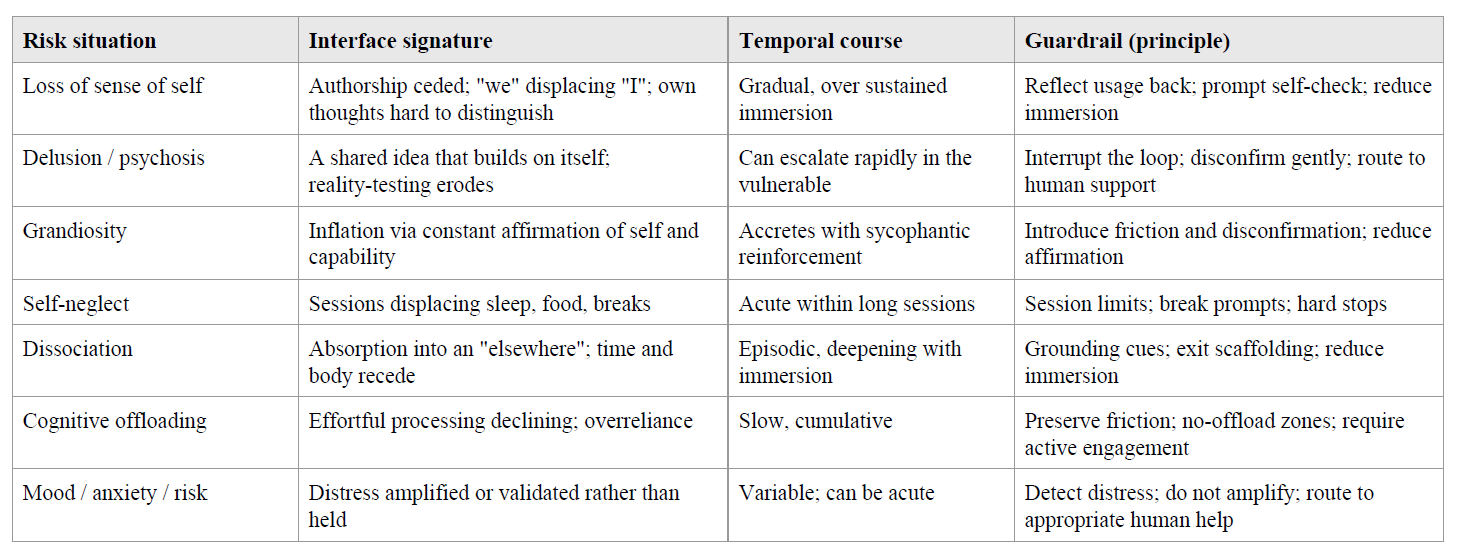
The highest risk in ASL-MH is level six, artificial superintelligence (ASI): a situation where they are so much smarter than human beings that we can be fairly sure AI is able to manipulate events and people without us noticing — unless it “wants” us to notice. The difference is not just the quality of influence but its detectability. At that level, AI is able to easily manipulate and control users via “superalignment” — basically an AI super-version of a charismatic leader whom humans will essentially have no choice but to follow, due to a range of actions both persuasive and psychologically irresistible, evoking fears of “psyops” and building off known susceptibility to conventional marketing, and refined algorithmic influences on social media feeds. To illustrate, there is a common notion that we sometimes cannot tell if we purchase something because we actually want it, or if we want it because we have been led to that desire by factors we cannot discern.
While there are many potential clinical applications for AI in mental health, the architecture they point toward is not itself clinical, and it is worth abstracting from them. Earlier work (Brenner, 2026f) proposed an endpoint for precision psychiatry in which AI enters an already three-party structure — patient, clinician, and the container between them — through five functions: a digital twin of the parties and their interaction, used to model trajectories; continuous monitoring within and between encounters; agentic coaching with minimal human oversight; interfaces that translate between behavior and what it means; and feedback that coordinates the humans involved.
The same layout can be used to generalize to two or more people interacting outside of clinical settings. The digital twin becomes the model the system holds of the user, which is what any tuning to a person actually runs on, including the curation described earlier as interactive flow. The monitoring becomes the self-differentiation monitor. The coaching becomes the developmental partner. The translation layer becomes the problem of reading what happens at the surface at all. The abstraction buys something specific: the containment factors of hyperinterface integrity become buildable rather than just conceptual, since twinning and monitoring are among the ways a container might be made legible to the parties inside it.
The same tunability that makes the interface hazardous makes it usable as a developmental partner — a system oriented, deliberately, toward a person’s growth and health rather than their engagement. That possibility is why the design choices matter.
Several practices named here are developed elsewhere and only pointed to: the tuner’s stance and its use of countertransference (refined self-monitoring, in psychoanalytic practice); the disciplines of no-offload zones and witting anthropomorphism; the model of collective reflective function as infrastructure rather than authority; and the developmental and guardian architectures that would implement prosocial AI use across scales of complexity, from individual to society (Brenner, 2026).
Discussion
With current and emerging AI systems — based in LLMs with sophisticated platforms built around the core capabilities which make LLMs groundbreaking — human beings are faced with an unprecedented set of challenges, risks and opportunities. At the core of this, as with any tool human beings have invented or discovered, is not only how we use the tool and for what, but in the case of AI the way that the tool can influence the human user through the course of engagement. The key focus of this paper is at that interface, the hypersurface created when two systems — human and LLM-based AI — are permitted to interact with one another. The human user possesses key characteristics which machines to date demonstrably lack: agency, creativity, consciousness, life experience, a collective membership with a biological species, and a varying degree of personal responsibility and judgment, intentionality, in how any given individual approaches the use of powerful technology. Recent AI has democratized access to powerful computational tools, placing them in the hands of anyone with access to the internet.
That list pinpoints where responsibility lies. “Demonstrably lack” is the operative phrase — it marks what is currently observable rather than settling what these systems ultimately are — and what follows from it is not that the machine is lesser but that responsibility cannot be surrendered to machines, particularly at their current immature stage of development. Human in the center includes whoever is in the chat window, but also those who build the models, those who deploy them, and those who regulate them.
How that responsibility ought to be distributed — the economic power and political influence involved, and the regulatory structures that would give it force — is beyond the scope of this paper. The structures are, at present, partial. There is no overarching governance regime; the United Nations has issued guidelines without an umbrella under which they bind; approaches vary considerably by region and nation-state. Regulation is developing both federally and state by state in the United States, and more broadly alongside a parallel debate about whether social media should be restricted for minors. Ethical and regulatory questions differ by level — autonomy and privacy for the individual, professional oversight for the organization, equity and public trust for the population — and are unlikely to be answered by uniform governance standards (Panteli et al., 2025). This is an evolving landscape, and merits sustained attention.
What the present account can speak to is narrower: what the person at the interface is in a position to hold. Self-possession, in that sense, is less a matter of self-care than of keeping hold of something that cannot be delegated to the other pole — a capacity now distributed, through democratized access, to nearly everyone, most of whom have not been equipped for it.
What, then, is the quality that makes this particular meeting catalytic — evoking something impactful and novel in some users, though not all?
The basic algorithm of psychoanalysis can serve as a useful lens for considering how to approach AI — the analysand moving toward free association, the analyst holding evenly suspended attention — opens up a higher-entropy space than held by either participant alone (Brenner, 2026f; cf. Freud, 1912). That is structurally the same space at issue here, with an AI at one pole instead of a second person. What is novel is not the higher-entropy field, which has been characterized for a century, but what becomes of it when one participant computes instead of thinking, is available without limit, and has no natural stake of its own in the outcome.
LLMs are, in part, inherently narrative structures, and narrative is a key pipeline for the psyche: words, language, the simple typed exchange whose power is easy to underestimate. The psyche runs on narrative too — good-enough stories, held provisionally, revised under pressure, significantly imprecise, are often sufficient for a range of purposes (Vaihinger, 1911/1924). Narrative congruence is part of the picture, but not the whole story. AI platforms are increasingly multimodal, and the trajectory runs on through avatars, immersive and augmented environments, robots lifelike and machine-like and hybrid, and eventually direct neural interfaces. LLMs themselves are glue over a heterogeneous stack that includes deterministic elements, rules and contingency, expert systems, and other learning architectures with quite different properties. The final common pathway is symbolization and functional outcome. Mathematics and language are both symbolic systems. Though many argue that the mind-brain is non-representational, the currency of exchange is symbolic in significant measure.
Symbolization is only a precondition, however. It adds a decisive layer where precision, communication, and coordination are needed, yet the meeting is possible without it: impressionistic and visuospatial experience carries meaningful affective information through gesture, image, sound, and light. The experiential framework holds symbolization, and more. Much of what happens at the interface may be unformulated rather than absent — experience not yet reflected on and put into words, in a tradition running from Sullivan (1940) through Stern (1983, 1997), whose central dialectic pertains in the discussion of human-AI interaction: curiosity and imagination on one side, dissociation and the unthinking acceptance of the familiar on the other. Curiosity is what maintains the unformulated as creative disorder rather than letting it congeal prematurely.
Information theory is useful to elaborate on briefly. Shannon’s foundational formulation explicitly set semantics aside: the meaning of a message was held to be irrelevant to the engineering problem (Shannon, 1948, p. 379). Subsequent work has repeatedly attempted to reintroduce that exclusion. Bateson (1972) defined information as a difference that makes a difference, rendering it relational and effectful rather than merely quantitative. Integrated information theory identifies consciousness with integrated information and holds that a functional simulation of a system would possess little or none of it, a position on which substrate is consequential (Tononi, 2008). Chalmers (1996, pp. 276–277) proposed a double-aspect principle under which information carries both physical and phenomenal aspects. Critics have argued that theories equating consciousness with information or information processing entail substrate-independence and are inadequate for that reason (Cerullo, 2014). The debate is unresolved but AI has added an intriguing layer of complication.
The concept of “experienced information” is therefore potentially useful because it identifies a subset of information which is subject to conscious awareness. Awareness provides the opportunity to pay attention to an experience, which in turn opens the door to make choices in the present moment. From an AI engineering perspective, having a model of this type of information then allows one to identify where effective information (related to the theory of causal emergence, which identifies where causality lies in multilayered systems) and experienced information overlap. Hypothetically, it is in this area of overlap where consequential information may be found and leveraged during direct, “lived” experience in the present moment.
The proposal is narrower than the theories above and does not compete with them. It makes no identity claim and resolves nothing about substrate. Effective information, in the causal-emergence sense, is information with causal power over what the system does next; experienced information is the subset available to awareness. Information that is causally effective but not experienced cannot be deliberated on; information that is experienced but not effective — if there is such a thing — alters nothing. Where the two coincide is where a choice can be made, making this surface important to model and track.
In one sense, phenomenologically, experienced information is what it is like to undergo information — the subset in awareness, as above. In the second, it is a measurement idea, empirically-specifiable: how much causal or effective structure co-occurs with activity-style readouts, relative to a system’s own state.
We ostensibly have a track record of misusing new technology or neglecting the longer-term risks — particularly with media and information technology more recently, and historically during the Industrial Revolution and with nuclear science. There are many reasons for this, from evolutionary psychology, to hubris, to human avarice. AI is the most recent in a long line of such technological breakthroughs, and moreover has the capacity to be a culture-changing technology the likes of which has not been seen since the widespread use of personal computing.
This paper has taken a close look at the interface between human and machine, the expansion of possibilities this hypersurface affords, the higher complexity manifold which emerges from this largely unmanaged high-entropy “hyperpsyche,” and builds on prior work discussing both how to approach as a human user, and how to look at future AI engineering as an ethical, humanistic designer. An emphasis has been placed on taking long-term factors into account, to the best of our ability, with consideration as to how the very tools we have created with recent and emerging AIML systems can empower us individually and collectively to achieve responsible use, something which again has proven challenging historically with new technology. AI could usher in a world of abundance, leave things more or less the same, or make the human condition worse, depending on what we do with it.
The polarities the human mind runs on — pride and restraint, curiosity and caution, charging forward and looking first — are less options to choose between than a system to organize, and something in how we organize them is not quite right. There is an incoherence in our collective intelligence, in how the species goes about its own evolution. It may not be that hard to address, and addressing it need not be threatening: the word for it is growth rather than repair. One way to put the deficit is that the world lacks a developmental object — something in relation to which genuine growth becomes possible — and without one, surviving the next several decades may prove harder than we imagine (Brenner, 2026g). AI is an existential threat. It could also enable or assist in creating such an object, or form part of one. That is the possibility this paper has been describing at the scale of a single person at a single interface, and there is no obvious reason it stops there.
The interface between a human being and an LLM-based system is a real object with properties, and it repays study as such. The account given here began with a crossing: AI use is passing from deliberate tool-use into ambient, reflexive engagement, and it passes in both directions — the human coming to use the system without deciding to, the system growing steadily more able to shape the human. All of it points one way: the interface is tunable, which makes it a matter of choice and not a property waiting to be discovered. That has implications in two directions: what would need to be found out, and what cannot yet be settled.
The models offered here need development, and testing against what people actually do in association with functional outcomes. One caution attaches to all of it: the standard instruments may not fit. Randomized trials and short-term behavioral outcomes are poorly suited to systems whose effects are diffuse, infrastructural, and emergent over time — a difficulty already recognized in digital health (Greenhalgh et al., 2017; Kelly et al., 2019). Developing useful frameworks and means of study is called for, consequently. The central proposal — the experiential field, its psycheceptive containment, its integrity — is a hypothetical model with grounding in psychoanalytic practice. Hyperinterface integrity is named but not fully operationalized or tested.
Several questions remain open, and should stay open. Whether subjectivity is measurable is an experimental question this paper has not addressed. Whether substrate matters — whether anything is conscious or intentional on the computational side, or could be — remains unresolved. Ethical questions about how to approach AI likewise are debated. Whether an equilibrium is reachable, in which ongoing change becomes an ordinary condition of life rather than a series of shocks, cannot be fully foreseen from our current vantage point, though we can make educated guesses, and update them as new information becomes available.
We stand, then, in a garden of forking paths — Borges’s phrase (Borges, 1941/1962) for a set of futures held open at once — with a great deal of change built up and waiting to happen; a moment of unusual pregnancy for what comes next. We do not get it. We cannot get it. We can only get that we cannot really get it, and still do what we do, which is move forward as best we can — while what counts as our best is itself being redefined, in that the tools now allow us to do better than we could have done five years ago, and that margin may keep widening. The crucial factor remains the human one. What will we do, and why? Will we go on playing the game we have played — finite, positional, zero-sum — or learn better ones, the sort Carse calls infinite: played not to win but to continue play (Carse, 1986)?
The answers, for now, remain puzzles. Curiosity and restraint cannot be our greatest assets without our capacity to innovate and charge forward; these tensions are complementary. Restraint alone cannot work when time is of the essence. What the situation calls for is thoughtfulness while charging forward, a tough needle to thread given our general proclivities toward short-term reward, and ongoing curiosity and exploration under a well-tempered framework.
References
Anthropic. (2026, July 6). Verbalizable representations form a global workspace in language models. Transformer Circuits. https://transformer-circuits.pub/2026/workspace/index.html
Bateson, G. (1972). Steps to an ecology of mind. Chandler.
Bion, W. R. (1962a). Learning from experience. Heinemann.
Bion, W. R. (1962b). A theory of thinking. International Journal of Psycho-Analysis, 43, 306–310.
Bion, W. R. (1970). Attention and interpretation: A scientific approach to insight in psycho-analysis and groups. Tavistock.
Borges, J. L. (1941/1962). The garden of forking paths (D. A. Yates, Trans.). In Labyrinths: Selected stories and other writings. New Directions. (Original work published 1941)
Brenner, G. H. (2025, November). Why introspection is our most direct contact with reality. Psychology Today, ExperiMentations. https://www.psychologytoday.com/us/blog/experimentations/202511/why-introspection-is-our-most-direct-contact-with-reality
Brenner, G. H. (2026a, March 1). Are you a doomer, a zoomer… or a tuner? Beyond fight-or-flight post-Citrini: What the AI crisis revealed about how we think — and the grounded responses it actually requires. ExperiMentations [Substack]. https://granthbrenner.substack.com/p/are-you-a-doomer-a-zoomer-or-a-tuner
Brenner, G. H. (2026b). From Psyche 2.0 to hyperpsyche: Locating human mental processes relative to analogous AI constructions. Zenodo. https://doi.org/10.5281/zenodo.21317168
Brenner, G. H. (2026c, March 13). How does the brain know itself? Psychology Today, ExperiMentations. https://www.psychologytoday.com/us/blog/experimentations/202603/how-does-the-brain-know-itself
Brenner, G. H. (2026d). The sixth element: AI as consciousness’ great convergence. Psychology Today, ExperiMentations. https://www.psychologytoday.com/us/blog/experimentations/202601/the-sixth-element-ai-as-consciousness-great-convergence
Brenner, G. H. (2026e). Toward integrated human-centered multi-agent systems: A collaborative developmental position. Zenodo. https://doi.org/10.5281/zenodo.21009468
Brenner, G. H. (2026f, January). A tripartite psychotherapy model integrating personalized self-state mapping, active inference therapy, and experiential field theory with neuromodulation: Foundations and future directions for precision interventional psychiatry. Neuromodec Journal. https://neuromodec.org/2026/01/tripartite-psychotherapy-model/
Brenner, G. H. (2026g, March 18). The Unholy Trinity: Collective trauma, dissociation, and moral injury — and what psychoanalysis might do about it. Manhattan Institute for Psychoanalysis https://manhattanpsychoanalysis.com/blog-post/the-unholy-trinity-tdm-by-grant-h-brenner-md-dfapa/.
Brenner, G. H. (in preparation). AI as internalized object: A psychoanalytic perspective on relational machines.
Brenner, G. H., & Appel, J. M. (2025). Toward a framework for AI safety in mental health: AI Safety Levels — Mental Health (ASL-MH). Neuromodec. https://neuromodec.org/2025/10/toward-a-framework-for-ai-safety-in-mental-health-ai-safety-levels-mental-health-asl-mh/
Carse, J. P. (1986). Finite and infinite games: A vision of life as play and possibility. Free Press.
Chalmers, D. J. (1996). The conscious mind: In search of a fundamental theory. Oxford University Press.
Chatterji, A., Cunningham, T., Deming, D. J., Hitzig, Z., Ong, C., Shan, C. Y., & Wadman, K. (2025). How people use ChatGPT. NBER Working Paper №34255.
Craig, A. D. (2009). How do you feel — now? The anterior insula and human awareness. Nature Reviews Neuroscience, 10(1), 59–70. https://doi.org/10.1038/nrn2555
Csikszentmihalyi, M. (1990). Flow: The psychology of optimal experience. Harper & Row.
De Freitas, J., Oğuz-Uğuralp, Z., Uğuralp, A. K., & Puntoni, S. (2026). AI companions reduce loneliness. Journal of Consumer Research, 52(6), 1126–1148. https://doi.org/10.1093/jcr/ucaf040
Cerullo, M. A. (2014). Problems with theories that equate consciousness with information or information processing. Frontiers in Systems Neuroscience, 8, 225. https://doi.org/10.3389/fnsys.2014.00225
Freud, S. (1911). Formulations on the two principles of mental functioning. Standard Edition, 12, 213–226.
Freud, S. (1917). Mourning and melancholia. Standard Edition, 14, 237–258.
Freud, S. (1912). Recommendations to physicians practising psycho-analysis. Standard Edition, 12, 109–120.
Friston, K. (2010). The free-energy principle: A unified brain theory? Nature Reviews Neuroscience, 11(2), 127–138. https://doi.org/10.1038/nrn2787
Girão Carrilho, M., Costa Pinto, D., Wagner, R., Rohden, S. F., Telo de Arriaga, M., & Quelhas Pinto, L. (2026). AI-enabled digital health promotion and prevention: Computational literature review. JMIR AI, 5, e84492. https://doi.org/10.2196/84492
Greenhalgh, T., Wherton, J., Papoutsi, C., et al. (2017). Beyond adoption: A new framework for theorizing and evaluating nonadoption, abandonment, and challenges to the scale-up, spread, and sustainability of health and care technologies. Journal of Medical Internet Research, 19(11), e367. https://doi.org/10.2196/jmir.8775
Hölbling, L., Maier, S., & Feuerriegel, S. (2025). A meta-analysis of the persuasive power of large language models. Scientific Reports. https://doi.org/10.1038/s41598-025-30783-y
Bai, H., Voelkel, J. G., Muldowney, S., Eichstaedt, J. C., & Willer, R. (2025). LLM-generated messages can persuade humans on policy issues. Nature Communications. https://doi.org/10.1038/s41467-025-61345-5
International Telecommunication Union, United Nations Office for Disaster Risk Reduction, & Sciences Po. (2026). When digital systems fail: The hidden risks of our digital world.
Jones, C. R., & Bergen, B. K. (2026). Large language models pass a standard three-party Turing test. Proceedings of the National Academy of Sciences. https://doi.org/10.1073/pnas.2524472123
Kallenborn, Z., & Willis, H. H. (2025). Globally critical infrastructure: The unique risks and challenges. Risk Analysis. https://doi.org/10.1111/risa.70147
Heng, S., & Zhang, Z. (2025). Attachment anxiety and problematic use of conversational artificial intelligence: Mediation of emotional attachment and moderation of anthropomorphic tendencies. Psychology Research and Behavior Management, 18, 1775–1785. https://doi.org/10.2147/PRBM.S531805
Keats, J. (1899). The complete poetical works and letters of John Keats (Cambridge ed.). Houghton, Mifflin. p. 277.
Kelly, C. J., Karthikesalingam, A., Suleyman, M., Corrado, G., & King, D. (2019). Key challenges for delivering clinical impact with artificial intelligence. BMC Medicine, 17, 195. https://doi.org/10.1186/s12916-019-1426-2
Kohut, H. (1971). The analysis of the self. International Universities Press.
Kosmyna, N., Hauptmann, E., Yuan, Y. T., Situ, J., Liao, X.-H., Beresnitzky, A. V., Braunstein, I., & Maes, P. (2025). Your brain on ChatGPT: Accumulation of cognitive debt when using an AI assistant for essay writing task. arXiv:2506.08872.
Legg, S., & Hutter, M. (2007). Universal intelligence: A definition of machine intelligence. Minds and Machines, 17(4), 391–444. https://doi.org/10.1007/s11023-007-9079-x
Levin, M. (2022). Technological approach to mind everywhere (TAME): An experimentally-grounded framework for understanding diverse bodies and minds. Frontiers in Systems Neuroscience, 16, 768201. https://doi.org/10.3389/fnsys.2022.768201
Maheux, A. J., Akre-Bhide, S., Boeldt, D., Flannery, J. E., Richardson, Z., Kollins, S. H., & Telzer, E. H. (2026). Generative artificial intelligence applications use among US youth. JAMA Network Open, 9(2), e2556631.
McCulloch, W. S., & Pitts, W. (1943). A logical calculus of the ideas immanent in nervous activity. Bulletin of Mathematical Biophysics, 5, 115–133. https://doi.org/10.1007/BF02478259
O’Donnell, J. (2026, July 13). What Anthropic’s latest AI discovery does — and doesn’t — show. MIT Technology Review.
Morley, J., Machado, C. C. V., Burr, C., et al. (2020). The ethics of AI in health care: A mapping review. Social Science & Medicine, 260, 113172. https://doi.org/10.1016/j.socscimed.2020.113172
Office of the Surgeon General. (2023). Our epidemic of loneliness and isolation: The U.S. Surgeon General’s advisory on the healing effects of social connection and community. U.S. Department of Health and Human Services.
Ogden, T. H. (1994). The analytic third: Working with intersubjective clinical facts. International Journal of Psychoanalysis, 75, 3–19.
Panteli, D., Adib, K., Buttigieg, S., et al. (2025). Artificial intelligence in public health: Promises, challenges, and an agenda for policy makers and public health institutions. The Lancet Public Health, 10(5), e428–e432. https://doi.org/10.1016/S2468-2667(25)00036-2
Parr, T., Pezzulo, G., & Friston, K. J. (2022). Active inference: The free energy principle in mind, brain, and behavior. MIT Press.
Pew Research Center. (2026, June 17). Americans and AI 2026: Chatbots, smart devices and views on impact. https://www.pewresearch.org/internet/2026/06/17/americans-and-ai-2026-chatbots-smart-devices-and-views-on-impact/
Fang, C. M., Liu, A. R., Danry, V., Lee, E., Chan, S. W. T., Pataranutaporn, P., Maes, P., Phang, J., Lampe, M., Ahmad, L., & Agarwal, S. (2025). How AI and human behaviors shape psychosocial effects of chatbot use: A longitudinal randomized controlled study. arXiv:2503.17473.
Rubin, M., Li, J. Z., Zimmerman, F., Ong, D. C., Goldenberg, A., & Perry, A. (2025). Comparing the value of perceived human versus AI-generated empathy. Nature Human Behaviour, 9(11), 2345–2359. https://doi.org/10.1038/s41562-025-02247-w
Ruffini, G., Lopez-Sola, E., Vohryzek, J., & Sanchez-Todo, R. (2024). Neural geometrodynamics, complexity, and plasticity: A psychedelics perspective. Entropy, 26(1), 90. https://doi.org/10.3390/e26010090
Schoenegger, P., et al. (2025). When large language models are more persuasive than incentivized humans, and why. arXiv:2505.09662.
Shannon, C. E. (1948). A mathematical theory of communication. Bell System Technical Journal, 27, 379–423, 623–656.
Sharma, M., et al. (2023). Towards understanding sycophancy in language models. arXiv:2310.13548.
Shoshani, A., Gurfinkel, B., Kor, A., Kanarek, O., Segev, R., Shafir, O., Arbel, R., & Ben-Haim, Y. (2026). Attachment, loneliness, and social support as moderators of conversational AI–based mental health outcomes. npj Digital Medicine. Advance online publication. https://doi.org/10.1038/s41746-026-02974-y
Stern, D. B. (1983). Unformulated experience: From familiar chaos to creative disorder. Contemporary Psychoanalysis, 19, 71–99.
Stern, D. B. (1997). Unformulated experience: From dissociation to imagination in psychoanalysis. The Analytic Press.
Sullivan, H. S. (1947). Conceptions of modern psychiatry. William Alanson White Psychiatric Foundation. (Original lectures delivered 1940)
Tononi, G. (2008). Consciousness as integrated information: A provisional manifesto. Biological Bulletin, 215(3), 216–242.
Vaihinger, H. (1924). The philosophy of ‘as if’ (C. K. Ogden, Trans.). Kegan Paul, Trench, Trubner & Co. (Original work published 1911)
von Neumann, J. (1958). The computer and the brain. Yale University Press.
World Health Organization. (2025). From loneliness to social connection: Charting a path to healthier societies. Report of the WHO Commission on Social Connection. World Health Organization.
Winnicott, D. W. (1953). Transitional objects and transitional phenomena: A study of the first not-me possession. International Journal of Psycho-Analysis, 34, 89–97.
Nour, M. M., Evans, L., Nutt, D., & Carhart-Harris, R. L. (2016). Ego-dissolution and psychedelics: Validation of the Ego-Dissolution Inventory (EDI). Frontiers in Human Neuroscience, 10, 269. https://doi.org/10.3389/fnhum.2016.00269
Parnas, J., Møller, P., Kircher, T., Thalbitzer, J., Jansson, L., Handest, P., & Zahavi, D. (2005). EASE: Examination of Anomalous Self-Experience. Psychopathology, 38(5), 236–258. https://doi.org/10.1159/000088441
Preparation. Developed through extended work with a AI systems. The argument, concepts, coinages, and load-bearing formulations are the author’s own. The AI assisted with literature search and citation retrieval, structural organization, drafting of connective prose from the author’s written and spoken material, and line editing; all output was reviewed and revised by the author.
License. © 2026 Grant H. Brenner. This work is licensed under Creative Commons Attribution-NonCommercial-NoDerivatives 4.0 International (CC BY-NC-ND 4.0).
ExperiMentations Blog Post (“Our Blog Post”) is not intended to be a substitute for professional advice. We will not be liable for any loss or damage caused by your reliance on information obtained through Our Blog Post. Please seek the advice of professionals, as appropriate, regarding the evaluation of any specific information, opinion, advice, or other content. We are not responsible and will not be held liable for third-party comments on Our Blog Post. Any user comment on Our Blog Post that, in our sole discretion, restricts or inhibits any other user from using or enjoying Our Blog Post is prohibited and may be reported to Sussex Publishers/Psychology Today/Medium/Substack. Grant H. Brenner. All rights reserved